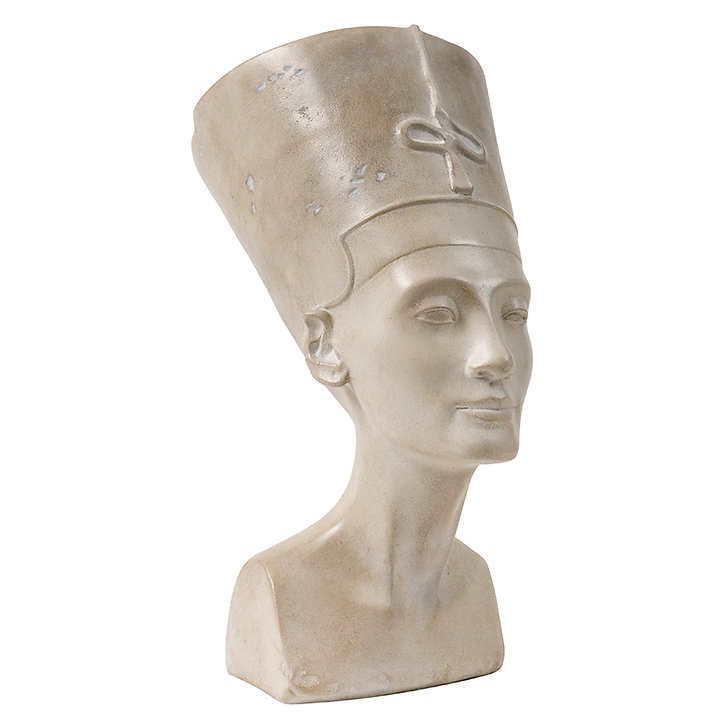
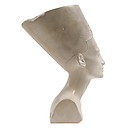
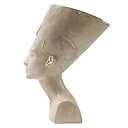
This resin cast reproduces the bust of Nefertiti housed in Berlin, measuring 26 x 13 x 19 centimeters and faithful to the original polychrome limestone sculpture. The hand-applied patina highlights the contours of the face and the principal forms of this bust of the queen, an iconic example of Amarna art.
History and Description
This reproduction of the bust of Nefertiti is crafted from resin by the Ateliers d'Art du Grand Palais RMN. Cast from a mold based on an impression taken of the original masterpiece, this 26 x 13 x 19-centimeter piece faithfully recreates its forms. A hand-applied patina recreates the nuances of the original polychrome limestone, giving each piece a refined finish.
This bust depicts Queen Nefertiti, wife of Akhenaten. Created around 1365-1349 BCE in Egypt and unearthed in 1912 at Amarna, the famous sculpture is housed at the Staatliche Museum in Berlin.
Further Reading on the Work
Is the Bust of Nefertiti Real or Fake?
For decades, the bust of Nefertiti has been the subject of controversy regarding its authenticity. Some researchers have raised the possibility of a hoax in Egyptology, suggesting that the German archaeologist Ludwig Borchardt, who discovered it in 1912 at Amarna, may have promoted a modernized artifact. Scientific analyses (X-rays, pigment studies), however, confirm the age of the limestone and the Amarna style. The work thus remains recognized as authentic, even though Egypt continues to demand its return.
Where is the bust of Nefertiti located in the Berlin museum?
The bust of Nefertiti is on display at the Neues Museum on Museum Island (Museumsinsel) in Berlin, accessible from the James-Simon-Galerie. It occupies a central position in the Nordkuppelsaal, the North Dome Hall, which was specially designed to showcase its splendor. It is in this setting-restored since the museum's reopening in 2009-that the Egyptian queen welcomes millions of visitors from around the world each year.
Why is the bust of Nefertiti in Berlin?
Discovered in 1912 in Amarna by the German archaeologist Ludwig Borchardt, the bust left Egypt as part of the division of the excavation finds with Germany, which had funded the research. Unveiled to the public in Berlin in 1924, it became one of the Neues Museum's most iconic artifacts. Since then, Egypt has regularly called for its return, arguing that this depiction of the Amarna royal family is part of its national heritage.