Postcard Marie Laurencin - The Does (detail), 1923

IC005718

MARIE LAURENCIN (1883-1956)
The Does (detail), 1923.
Oil on canvas. H. 73; W. 92 cm. Paris, Musée de l'Orangerie.
© Fondation Foujita / Adagp, Paris, 2025.
© Photo GrandPalaisRmn (Musée de l'Orangerie) / H. Lewandowski.
© GrandPalaisRmnCréations, Paris 2025.
Made in France.

Sold by GrandPalaisRmn

Characteristics

Maintenance
Store in a dry place, protected by a case or plastic bag
Themes
Animals, Made in France
Artist
Marie Laurencin (1883-1956)
Art movements
Modern & Contemporary Art, Cubism
Reference
IC005718
EAN
3336727168295
Matière de l'article
Coated paper
Model dimensions
10cm x 15cm
Package Dimensions
10cm x 15cm
Conservation museum
Paris - Musée de l’Orangerie - Collection Jean Walter et Paul Guillaume
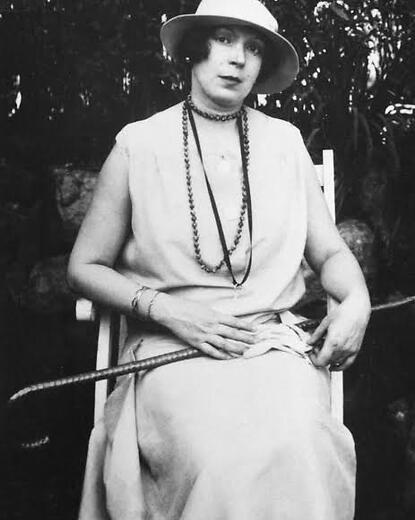
The work and its artist

Marie Laurencin (1883-1956)

Painter, engraver, illustrator, decorator or even poet, the French artist Marie Laurencin distingues herself with her artistic curiosity and the versatility of her creativity and talent, all along her career. As a pioneer of figurative art, caracterized by a mythical representation of the visible, she developps a style often called « nymphism », which draws inspiration from the surreal, magical atmospheres and oneiric creatures. Her works will fuel the cubic genre of Pablo Picasso and Georges Braque, or even the fauvist style of Henri Matisse. Marie Laurencin thus imposes herself as a fully-fledged artistic figure through the originality of her approach, and becomes one of the pioneers of the Dadaïst movement and its revendications in the 20th century.

In 1914, amongst the start of World War I, she marries the Pacifist German painter Otto de Waetjen, and is therefore deprived of her citizenship and forced to exile to Spain. The couple firstly finds refuge in Madrid, and progressively becomes part of a circle of artist refugees, composed of multiple cubists such as the Lithuanian Jacques Lipchitz or the Spanish painter Marie Blanchard, as well as figurative painters with Japanese artist Riichirō Kawashima. Precisely, Marie's aesthetics, marked by pastel tones and flexible lines, which profoundly echo with the japanese cultural sensibilities, will grant her with an absolute adulation in Japan, where a museum entirely dedicated to her will be founded in 1983.