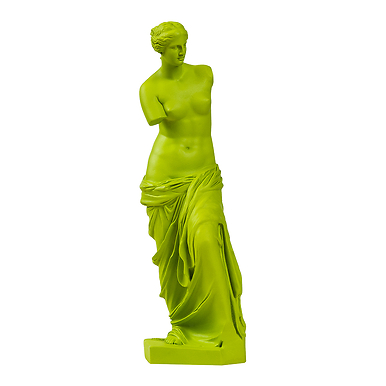
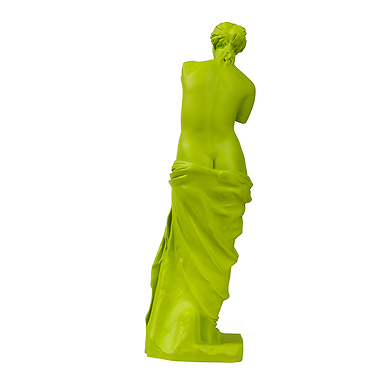
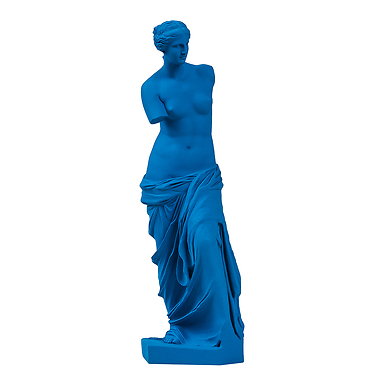
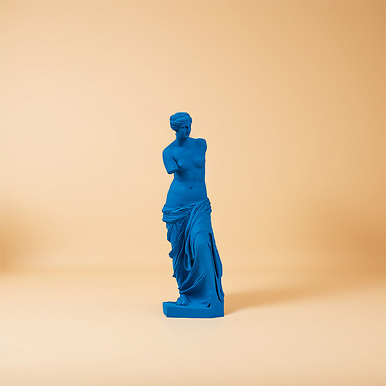
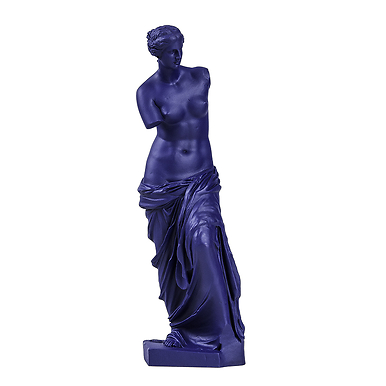
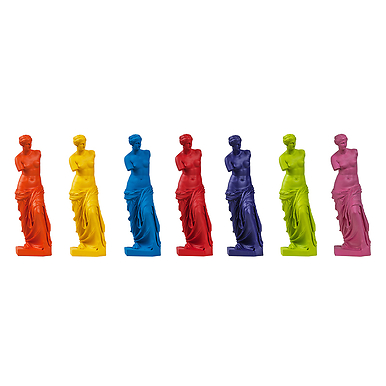
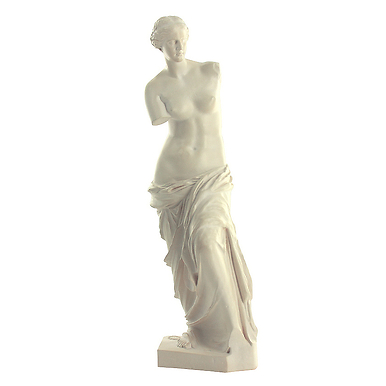
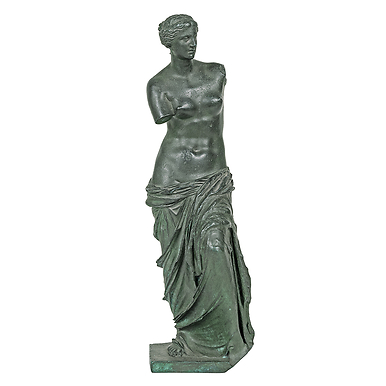
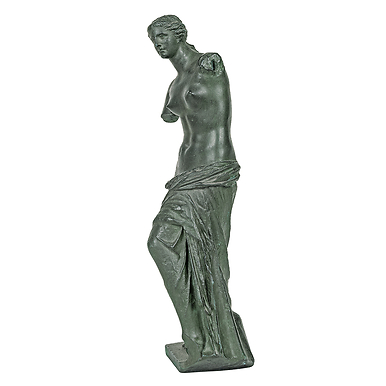
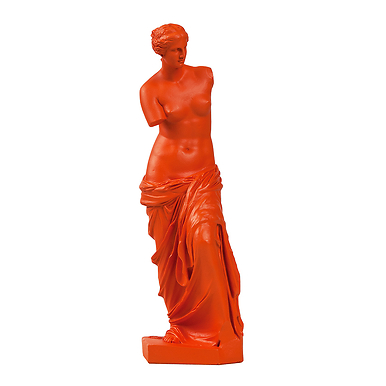
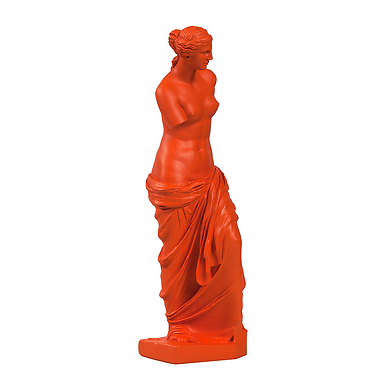
This hand-weathered resin reproduction is a cast of the Venus de Milo, made from a mould of the original work on display at the Louvre. Available in three sizes, ranging from 16 to 50 cm, the smallest version is presented on a plinth. This statue occupies a prominent place in the history of Greek sculpture and the appreciation of antiquity, and remains one of the most famous works held at the Louvre.
Further reading on the work
Who is the artist behind this Greek sculpture?
The creator of this Greek sculpture remains anonymous to this day - a mystery that has never diminished the fascination the work holds. His style, described as retrospective, is characteristic of the late Hellenistic period, a time when artists were returning to classical themes whilst allowing themselves new creative freedom. The sculptor follows in the tradition established two centuries earlier by Praxiteles, whose depiction of Aphrodite had left its mark on classical Greek art. Yet he managed to break free from this legacy to impose a personal vision, evident in the twisting movement that animates the entire body. Auguste Rodin himself praised the splendour of this belly, as vast as the sea, proof that this anonymous artist has left a lasting mark on the history of sculpture.
Why is the statue kept at the Louvre?
The statue was discovered by chance in 1820 on the island of Melos, in the south-west of the Cyclades, by a Greek peasant not far from the ruins of an ancient theatre. Presented to Louis XVIII on 1 March 1821, it immediately became part of the Louvre's collections, where it has been on display ever since. Its arrival in France was such a significant event that a commemorative medal was struck to mark the occasion. The admiration it aroused upon its arrival has never waned: the German poet Heinrich Heine had already dubbed it 'Our Lady of Beauty'. This veneration also explains why the statue has never been completed, contrary to the 19th-century practice of restoring mutilated ancient sculptures.
What does the torso of the Venus de Milo represent?
The torso of the Venus embodies all the sculptor's virtuosity. Animated by a twisting movement that runs through the entire body, it occupies every dimension of space and is truly perceived as a work in the round, designed to be admired from every angle. The modelling, with its decidedly realistic touches, lends the flesh an almost lifelike quality, a far cry from the somewhat stern coldness of the face. This swirling silhouette, both sensual and balanced, illustrates the genius of an artist capable of creating a dialogue between classical rigour and artistic audacity in a single sculptural gesture.
How is the cast of the Venus de Milo made?
Each cast of the Venus de Milo on offer here is a hand-patinated resin reproduction, made from a mould taken directly from the original Parian marble statue held at the Louvre. This tradition of casting dates back to 1821, when François-Henri Jacquet, master caster at the museum's casting workshop founded in 1794, produced the very first mould of the statue shortly after its arrival in France. The art workshops of the GrandPalaisRmn continue this historic craft today, ensuring meticulous fidelity to the original work. This direct link to Jacquet's pioneering work lends each cast of the Venus a legitimacy that goes beyond that of a mere decorative reproduction.